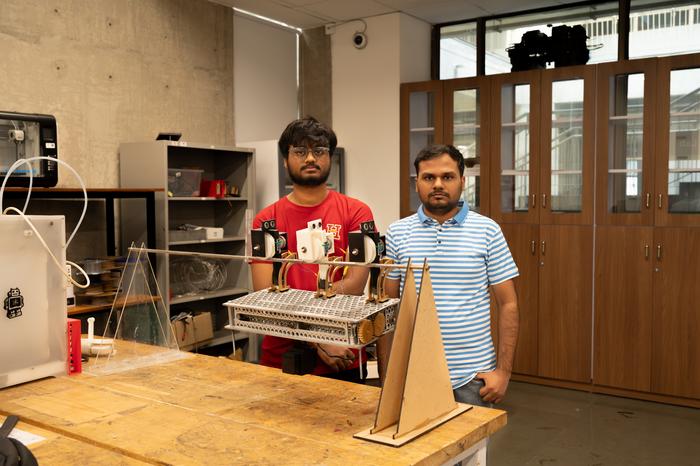
IIT Gandhinagar Engineering Students Built a Robot to Inspect India’s Ageing Power Lines
IIT Gandhinagar Engineering Students Built a Robot to Inspect India’s Ageing Power Lines
India’s power grid is one of the largest and most complex in the world, stretching across cities, villages, forests, and remote terrains. Suspended overhead, millions of kilometres of power lines quietly transmit electricity every day, largely unnoticed—until something goes wrong. Line failures can trigger outages, economic losses, and safety hazards, making inspection and maintenance a national priority. Yet, despite its importance, power-line inspection remains dangerous, expensive, and technologically constrained. Addressing this challenge, two undergraduate students from the Indian Institute of Technology Gandhinagar (IITGN) have developed a low-cost robotic system that could fundamentally change how ageing power infrastructure is monitored in India.
A Classroom Assignment That Uncovered a National Infrastructure Crisis
The idea took shape during a routine academic exercise in IIT Gandhinagar’s Mechanical Engineering curriculum. Students were tasked with identifying a real-world problem and developing a functional engineering solution. For Nikhil Kumar Lal, a final-year BTech student, and Manas Kalal, a fourth-year undergraduate, this assignment became an opportunity to look beyond textbooks and into India’s infrastructure landscape. The duo initially explored several domains, including underground pipelines and mechanical transmission systems, before turning their attention to overhead power lines.
As their research deepened, the severity of the issue became evident. According to industry data and field studies, nearly 30 per cent of total power losses in the grid are linked to line failures, and close to 80 per cent of those failures originate from deteriorated or poorly maintained transmission lines. These statistics highlighted a clear gap between the scale of the problem and the tools currently available to address it. What began as an academic requirement soon evolved into a mission to design a safer, more efficient inspection method.
The Limitations of Existing Power-Line Inspection Methods
Traditionally, power distribution companies rely on human inspection teams to visually assess overhead lines. Workers often climb tall towers or operate at dangerous heights near live electrical infrastructure, exposing themselves to significant risk. While safety protocols exist, accidents remain a persistent concern. In recent years, industrial drones have been introduced as an alternative, offering improved safety and faster coverage.
However, drones bring their own set of challenges. High-end inspection drones can cost ₹50–60 lakh, making them inaccessible to many utilities, especially in rural or resource-constrained regions. Battery limitations restrict flight duration, and adverse weather conditions—such as strong winds—can compromise stability and data quality. These constraints prompted Nikhil and Manas to rethink the inspection paradigm entirely.
Rethinking the Problem: Let the Wire Become the Pathway
Instead of inspecting power lines from above or placing humans directly on them, the students asked a deceptively simple question: why not use the power line itself as the robot’s route of movement? This conceptual shift became the foundation of their innovation.
Working from the Tinkerer’s Lab at IIT Gandhinagar, equipped with basic machining tools, levelling instruments, and a 3D printer, the duo began designing a robot capable of crawling directly along high-voltage transmission lines. Unlike drones that must constantly fight gravity, the robot conserves energy by resting on the wire and using it as a guiding track. This design enables longer inspection durations and improved stability over extended distances.
Built-in Intelligence for Detecting Faults Early
The prototype robot integrates both thermal and visual sensing systems to identify early signs of line degradation. The thermal camera plays a critical role by detecting abnormal heat generation—often a precursor to serious faults—caused by increased electrical resistance, material fatigue, or physical damage. Complementing this, a standard visual camera allows operators to inspect surface conditions, corrosion, and structural irregularities.
By combining these sensing capabilities, the robot provides utilities with actionable insights before minor issues escalate into costly failures. Such proactive inspection could significantly reduce downtime and improve overall grid reliability.
Also Read : Which IIT is famous for robotics?
Engineering Around Real-World Obstacles
One of the earliest challenges the team encountered was the lack of continuity along power lines. In real transmission systems, wires are interrupted by insulators, clamps, and support structures that can halt a simple rolling mechanism. Without a way to overcome these obstacles, the robot’s usefulness would be severely limited.
To address this, the students engineered a disengagement and re-engagement mechanism that allows the robot to temporarily detach from the wire, manoeuvre past obstructions, and securely reconnect. This feature enables uninterrupted inspection across long spans of complex infrastructure, making the system far more practical for real-world deployment.
Ensuring Stability in Unpredictable Conditions
Unlike controlled laboratory environments, outdoor power lines are constantly influenced by wind, temperature variations, and mechanical sag. These factors introduce vibrations and oscillations that can destabilise robotic systems. Excessive movement could cause the robot to lose contact with the line or topple entirely.
To counter this, the team designed a carefully balanced suspension and wheel-engagement system, ensuring the robot’s centre of mass remained stable during operation. A lead-damping mechanism was also incorporated to absorb oscillations and minimise vibrations. Through repeated testing and refinement, the prototype achieved improved stability even under dynamic conditions.

The Role of Mentorship and Iterative Design
The project was closely mentored by Dr Madhu Vadali, Associate Professor in IIT Gandhinagar’s Department of Mechanical Engineering. Through weekly review meetings, Dr Vadali guided the students in identifying key design flaws, refining mechanical systems, and adopting a structured trial-and-error approach.
Over a period of ten months, Nikhil and Manas spent long hours iterating on their design—redesigning robotic arms, repositioning batteries, recalibrating weight distribution, and improving engagement mechanisms. Each failed prototype provided insights that informed the next iteration, steadily increasing the system’s reliability and performance.
Also Read : List of Top Techfest at IITs in India
A Breakthrough in Cost Efficiency
Perhaps the most transformative aspect of the project is its affordability. While industrial-grade drones used for power-line inspection can cost upwards of ₹50 lakh, the students developed their working prototype for approximately ₹15,000. They estimate that a commercially viable version, built with industrial-grade components, would cost between ₹3–4 lakh—a fraction of existing solutions.
This dramatic reduction in cost has the potential to democratise power-line inspection, enabling smaller utilities and rural power distributors to adopt advanced monitoring technologies without prohibitive investment.
Industry Recognition and Funding Support
The innovation has already attracted industry attention. Infineon Technologies India Private Limited selected the project under its national CSR initiative aimed at supporting young innovators, providing funding of ₹5,00,000. Additional financial support of ₹62,500 was received from Hyundai Motor Group, helping the team advance beyond a lab-scale prototype.
Encouraged by this momentum, the students have filed a provisional patent and plan to submit a final patent application by 2026 as part of their commercialisation strategy.
Looking Ahead: From Prototype to Power Grid Deployment
The team is now focused on addressing the final technical hurdles required for real-world deployment. These include enabling smooth operation on naturally sagging and curved transmission lines and developing electromagnetic shielding to protect sensitive electronic components from high-voltage fields.
Beyond mechanics, the students envision expanding the robot’s sensing capabilities and transforming it into a comprehensive grid diagnostic platform. They are actively seeking collaborations with power utilities and industry partners to conduct field trials and refine their business model based on real user feedback.
Student Innovation with National Impact
From a classroom assignment to a solution with the potential for nationwide impact, the journey of Nikhil Kumar Lal and Manas Kalal underscores the power of student-led innovation. Supported by mentorship, institutional infrastructure, and industry collaboration, their work demonstrates how engineering education can directly address pressing societal challenges.
By reducing costs, eliminating safety risks for workers, and enabling more frequent inspections, this power-line crawling robot could play a vital role in strengthening India’s ageing power infrastructure—bringing safer, more reliable electricity to millions.
Related
Table of Contents
Toggle

