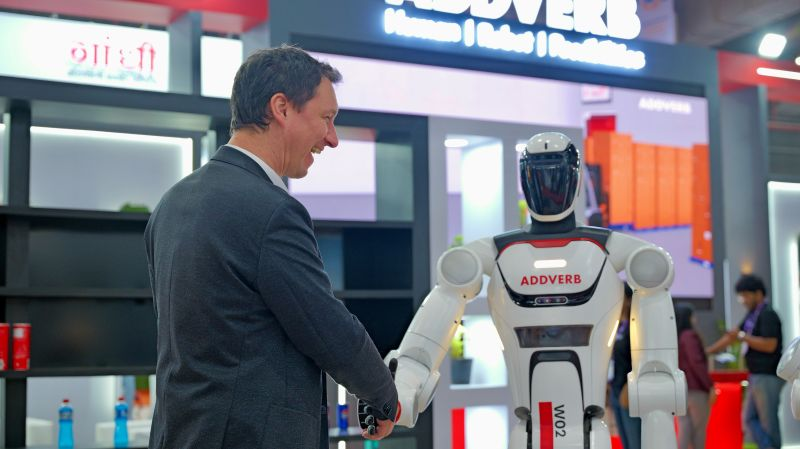
Addverb Launches Elixis-W: India’s First Wheeled Humanoid Robot
Addverb Launches Elixis-W: India’s First Wheeled Humanoid Robot
The global robotics industry is transitioning toward humanoid systems capable of operating in real-world industrial environments. Addverb Technologies has introduced Elixis-W, India’s first wheeled humanoid robot designed specifically for warehouse, logistics, and industrial automation use cases. This development positions India as an emerging contributor to next-generation humanoid robotics.
Introduction to Humanoid Robotics in Industry
Humanoid robots represent a significant evolution in industrial automation. Unlike traditional automated guided vehicles (AGVs) or fixed robotic arms, humanoid robots are designed to function in environments originally built for humans. Global initiatives such as Tesla Optimus and Boston Dynamics Atlas have demonstrated the potential of humanoid robots, but widespread deployment remains limited by cost, energy efficiency, and operational complexity.
Addverb’s Elixis-W adopts a wheeled humanoid architecture, prioritizing stability, energy efficiency, and industrial scalability over bipedal locomotion.
Also Read: Why Reliance Invested $132 Mn In This Indian Robotics Startup Addverb
Overview of the Elixis-W Humanoid Robot
Elixis-W is a wheeled humanoid robot engineered for enterprise environments. Its design allows seamless operation within existing warehouse infrastructure, minimizing the need for structural modifications.
Design Philosophy
- Industrial-first architecture
- Optimized for repetitive and high-frequency tasks
- Human–robot collaboration focused
- Integration with warehouse management systems
Core Technical Architecture
Mobility System
Elixis-W utilizes an autonomous wheeled mobility platform that enables precise navigation in structured and semi-structured environments. Compared to bipedal humanoids, wheeled locomotion significantly improves energy efficiency and operational uptime.
Manipulation and Actuation
The robot is equipped with dual humanoid arms capable of performing picking, placing, and material handling tasks. Advanced end-effectors and force-control algorithms enable safe and reliable object manipulation.
Perception and AI Stack
Elixis-W integrates a multi-modal perception system combining 3D vision, depth sensing, and sensor fusion. AI-driven object recognition and localization allow the robot to operate in dynamic warehouse environments.
Autonomy and Control
Autonomous navigation, real-time obstacle avoidance, and adaptive task execution enable Elixis-W to safely operate alongside human workers while meeting industrial safety standards.
Industrial Use Cases
Warehouse and Logistics
Elixis-W is designed for picking and placing operations, material transport, inventory handling, and loading or unloading assistance in logistics facilities.
Manufacturing and Smart Factories
In manufacturing environments, Elixis-W supports intralogistics, assembly assistance, and component handling, aligning with Industry 4.0 requirements.
Comparative Positioning with Global Humanoid Robots
| Feature | Elixis-W | Tesla Optimus | Boston Dynamics Atlas |
|---|---|---|---|
| Mobility | Wheeled | Bipedal | Bipedal |
| Primary Use Case | Warehousing and logistics | General-purpose | Industrial research |
| Energy Efficiency | High | Moderate | Low |
| Deployment Readiness | Enterprise-focused | Experimental | Limited commercial |
Impact on India’s Robotics Ecosystem
The launch of Elixis-W reflects India’s growing capabilities in advanced robotics engineering. It strengthens the domestic robotics ecosystem and supports initiatives such as Make in India and industrial digital transformation.
Business and Economic Implications
Enterprises deploying Elixis-W can benefit from reduced dependency on manual labor, improved operational efficiency, enhanced safety, and scalable automation without major infrastructure changes.
Challenges and Future Outlook
Challenges include long-term reliability, global regulatory compliance, and system integration complexity. Future iterations are expected to improve dexterity, AI reasoning, and task generalization.
Conclusion
Addverb’s Elixis-W represents a practical step forward in humanoid robotics. By focusing on industrial usability and operational efficiency, it positions itself as a strong candidate for large-scale deployment in global logistics and automation environments.


