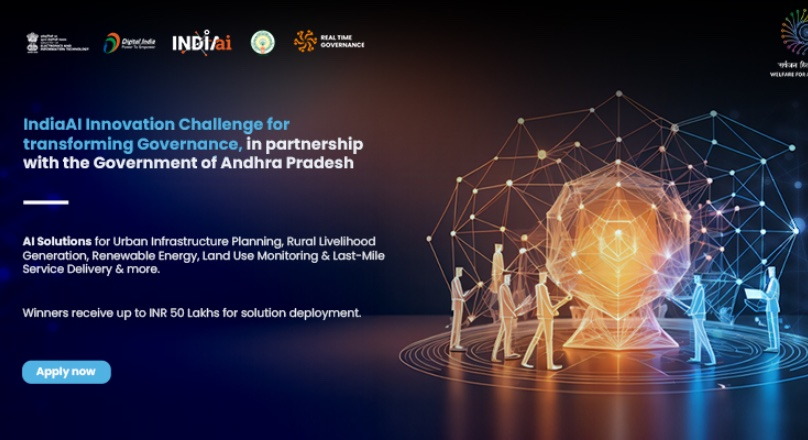
IndiaAI Innovation Challenge for Transforming Governance (with Government of Andhra Pradesh)
IndiaAI Innovation Challenge for Transforming Governance (with Government of Andhra Pradesh)
IndiaAI, an initiative of the Ministry of Electronics and Information Technology (MeitY), in collaboration with the Real Time Governance Society (RTGS) and multiple line departments of the Government of Andhra Pradesh, has launched the IndiaAI Innovation Challenge for Transforming Governance.
The challenge is designed to catalyse the adoption of artificial intelligence–driven solutions to address complex governance challenges and strengthen public service delivery systems across India. By bringing together government departments, startups, research institutions, and technology providers, the initiative aims to demonstrate how AI can enable data-driven decision-making, operational efficiency, transparency, and inclusive growth.
The solutions developed under this challenge are expected to be cross-sectoral, scalable, and replicable nationwide, enabling deployment across states, departments, and public-sector organisations.
About the Challenge
The IndiaAI Innovation Challenge focuses on leveraging AI technologies to solve real-world governance problems across six strategic domains identified by the Government of Andhra Pradesh. These domains span both urban and rural contexts and address service delivery gaps, infrastructure planning inefficiencies, and data limitations that affect governance outcomes.
The challenge areas include:
- Empowering rural entrepreneurs and Self-Help Groups (SHGs) through intelligent market linkages
- Optimising supply chains for essential goods and welfare services
- Streamlining land identification and allocation for renewable energy projects
- Strengthening urban infrastructure planning using predictive analytics
- Monitoring land-use changes and property data through satellite imagery
- Enabling predictive infrastructure planning for government schools
By embedding AI into these domains, the initiative seeks to enhance transparency, reduce manual interventions, improve planning accuracy, and accelerate service delivery, while ensuring that technological innovation directly contributes to socio-economic development.
Challenge Objectives and Problem Statements
The primary objective of the challenge is to identify, validate, and deploy high-impact AI solutions that can significantly improve governance processes and public service outcomes. Working closely with relevant line departments of the Government of Andhra Pradesh, six problem statements have been defined where AI adoption can create measurable public value.
1. Smart Market Linkage for Self-Help Groups (SHGs)
Department: Municipal Administration & Urban Development
This problem statement seeks an AI-powered platform that can provide market intelligence, demand forecasting, price trends, and buyer discovery for products manufactured by SHGs. The solution should help SHG members access broader markets, improve pricing power, and enable sustainable income generation.
2. Last-Mile Delivery Optimisation
Department: Women Development & Child Welfare
The objective is to deploy AI-based systems to monitor, optimise, and ensure timely delivery of essential government supplies, such as nutrition and welfare services, to beneficiaries. Solutions should improve visibility across supply chains, identify bottlenecks, and reduce leakage or delays.
3. Renewable Energy Land Allocation
Department: New & Renewable Energy Development Corporation of Andhra Pradesh
This problem statement calls for a GIS-enabled AI solution that can automate the identification and allocation of suitable land parcels for solar and wind energy projects. The system should minimise land-use conflicts, ensure regulatory compliance, and accelerate project approvals.
4. Urban Infrastructure Planning
Department: Roads and Buildings
The focus here is on developing a decision-support system that uses traffic data, mobility patterns, and urban growth indicators to assist government agencies in planning bridges, flyovers, and other critical infrastructure. AI-driven insights should support better investment decisions and long-term urban planning.
5. School Infrastructure Validation and Forecasting
Department: School Education
This problem statement seeks an AI model capable of forecasting infrastructure requirements for government schools, based on enrolment trends, demographic data, and existing infrastructure gaps. The solution should support proactive planning and equitable allocation of resources across the state.
6. Urban Land Use Monitoring
Department: Municipal Administration & Urban Development
Applicants are invited to develop an automated system using satellite imagery and AI-based change detection to identify properties, monitor land-use changes, and support urban governance. The solution should enhance compliance, improve data accuracy, and enable timely policy interventions.
Detailed descriptions and datasets related to each problem statement are available in the Submission Guidelines.
Eligibility and Who Can Apply
The challenge is open to a wide range of Indian entities with demonstrated AI capabilities:
- Indian Companies registered under the Companies Act, 2013, with at least 51% ownership by Indian citizens or persons of Indian origin
- Start-ups recognised under the latest notification issued by the Department for Promotion of Industry and Internal Trade (DPIIT)
- Autonomous Bodies, including public sector organisations, non-profit entities, research institutions, and universities
Applicants must submit existing AI-enabled products, services, or business models that have already been piloted or deployed and are ready for scaling through government adoption.
Challenge Structure and Major Milestones
The challenge will be conducted in a phased manner:
- Stage 1: Registration and Solution Submission
Applicants must register and submit their solutions through the AIKosh platform. - Stage 2: Evaluation
Submissions will be assessed based on innovation, scalability, technical robustness, and potential socio-economic impact. - Stage 3: Solution Refinement and Testing
Up to three shortlisted teams per problem statement will receive ₹5 lakh each to refine, customise, and test their solutions using a shared government dataset. - Stage 4: Deployment and Scale-Up
Up to one team per problem statement may be awarded a one-year work order of up to ₹50 lakh to deploy the solution within the government ecosystem.
Key Dates
- Challenge Launch: 23 January 2026
- Submission Deadline: 22 February 2026
How to Apply
Interested applicants can access detailed guidelines and submit their proposals by visiting the official application portal. Click here to apply.
Information Webinar
To support potential applicants and provide clarity on problem statements, evaluation criteria, and implementation expectations, an information webinar is being organised.
The webinar is open to startups, innovators, researchers, academic institutions, non-profits, private enterprises, and industry professionals developing AI solutions for governance, public service delivery, and inclusive growth.
Date: 10 February 2026
Time: 03:00 – 04:00 PM (IST)
Speakers
- Smt. Ankita Pandey, Director (RAMP and Legal Cell), Ministry of MSME
- Sh. Swadeep Singh, General Manager – Data Science, IndiaAI
- Sh. Naman Goyal, Officer on Special Duty (Ayush Grid), Ministry of Ayush
Webinar Registration Link:
https://zoom.us/webinar/register/WN_3ocyDJ8uQYq6MoA7xQnM1w#/registration
Queries and Support
All pre-submission queries must be sent via email to:
fellow3.gpai-india@meity.gov.in
Email Subject:
Query – IndiaAI Transforming Governance Challenge 2026 – Applicant Name
Also Read: Transforming India with AI


