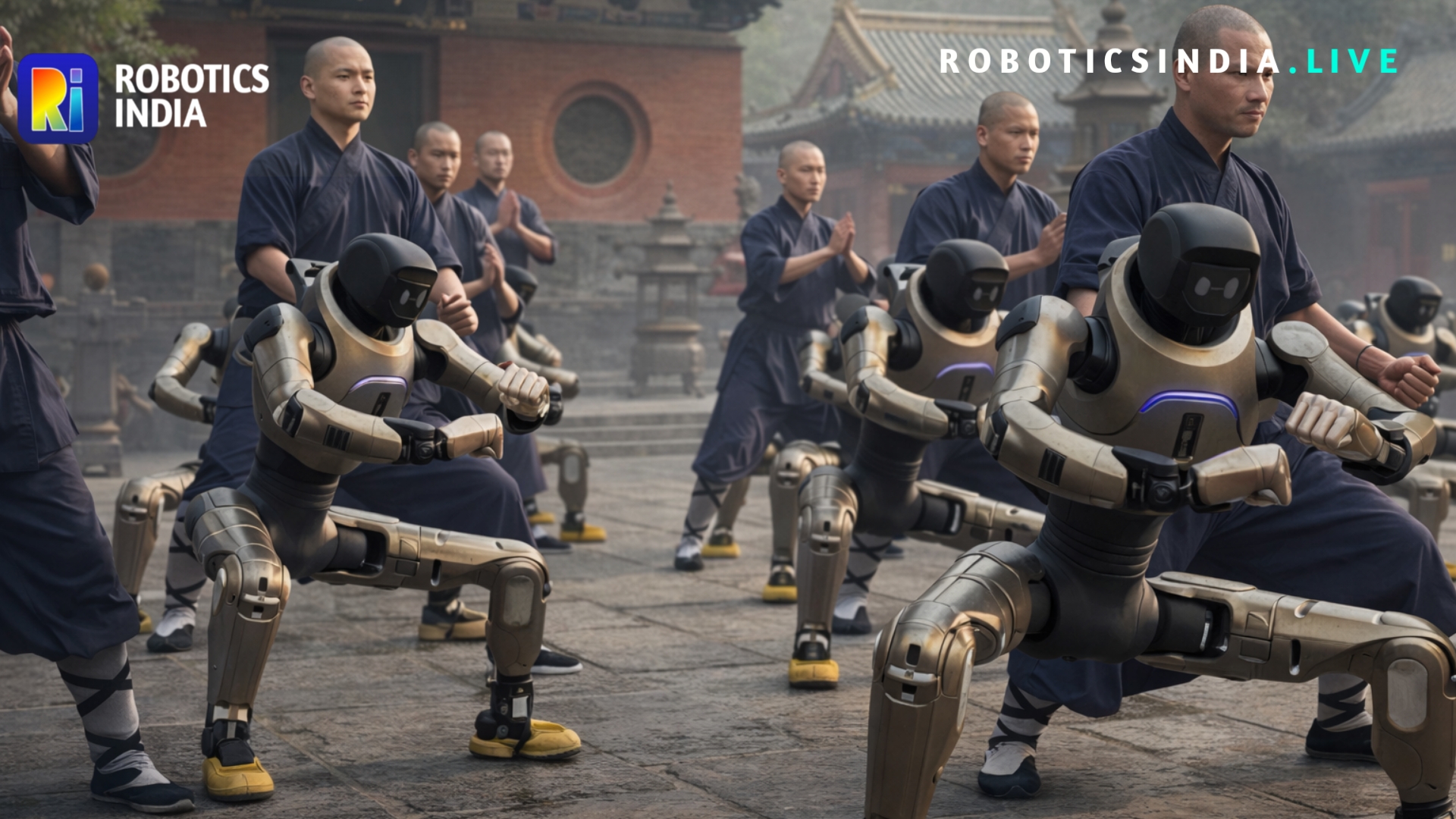
At China’s Shaolin Temple Humanoid Robots Become Kung Fu Trainees
At China’s Shaolin Temple Humanoid Robots Become Kung Fu Trainees
Marketing Spectacle or a Glimpse Into the Future of Industrial Robotics?
China has once again captured global attention—this time by blending ancient tradition with cutting-edge technology. At the legendary Shaolin Temple in Henan Province, humanoid robots were seen training alongside Shaolin monks, performing traditional Kung Fu movements such as stances, punches, and coordinated routines.
The visuals quickly went viral: white humanoid robots mirroring monks who have practiced martial arts for decades. But beyond the spectacle lies a deeper question—is this just a marketing stunt, or proof that humanoid robots are becoming genuinely useful for industry and real-world applications?
For tech enthusiasts, the answer is far more interesting than it appears on the surface.
Humanoid Robots at the Shaolin Temple: What Actually Happened?
The robots involved in the Shaolin Temple demonstration were developed by a Chinese robotics company specializing in general-purpose humanoid robots. These machines are designed to walk, balance, observe their environment, and perform complex physical tasks.
At the temple, the robots executed predefined Kung Fu routines under human supervision. Monks guided the timing and positioning, while the robots replicated movements such as horse stances, kicks, and arm techniques.
Importantly, this was not a spiritual or cultural shift within Shaolin Buddhism. The monks were not training robots as disciples. Instead, the event was framed as a technology demonstration and cultural exchange, showcasing how far embodied AI and robotics have progressed.
Also Read: China Humanoid Robot Games
The Technology Behind “Robot Kung Fu”
Kung Fu may look artistic, but from an engineering perspective, it is brutally difficult.
Martial arts movements require:
- Precise balance and center-of-gravity control
- Real-time motion coordination
- Multi-joint synchronization
- Rapid correction after instability
These are the same challenges robots face in factories, warehouses, and disaster-response environments.
The humanoid robots used at Shaolin are equipped with:
- High-resolution vision systems
- Motion sensors and gyroscopes
- Advanced joint actuators
- AI-driven motion control algorithms
They are capable of standing up after disturbance, maintaining posture on uneven surfaces, and executing complex sequences smoothly. While the Kung Fu routines were programmed rather than learned organically, they served as a stress test for full-body coordination—something industrial robots struggle with far more than simple arm movements.
Also Read : ABU Robocon 2026 Theme Hong Kong China
Is This Just Marketing?
Let’s be honest: yes, partially.
The Shaolin Temple setting was chosen because it is iconic, symbolic, and guaranteed to go viral. Robots practicing Kung Fu generate far more attention than robots stacking boxes in a warehouse.
However, calling it “just marketing” would miss the bigger picture.
The robots involved are not props or CGI concepts. They are part of a rapidly growing ecosystem of mass-produced humanoid robots already deployed in real environments.
These same platforms are currently used for:
- Factory assembly assistance
- Warehouse logistics
- Security patrols
- Reception and customer service
- Public space guidance and inspection
The Kung Fu demonstration doesn’t replace monks—but it demonstrates physical intelligence, which is exactly what industry needs next.
Why Humanoid Robots Matter for Industry
Traditional industrial robots are excellent at repetitive tasks in controlled environments. Humanoid robots aim to solve a different problem:
Operating in spaces built for humans.
Factories, hospitals, hotels, and construction sites are designed around human height, reach, and movement. Humanoid robots don’t require full infrastructure redesign—they can walk, use tools, open doors, and navigate stairs.
Kung Fu movements test:
- Dynamic balance
- Whole-body coordination
- Fast response to motion changes
These capabilities directly translate to industrial use cases like:
- Carrying objects across uneven floors
- Working safely around humans
- Adapting to non-fixed workflows
From this perspective, robot Kung Fu is less about fighting—and more about mobility intelligence.
China’s Bigger Humanoid Robot Push
The Shaolin robots are part of a much larger national trend.
China has heavily invested in humanoid robotics as a strategic technology, with companies deploying robots in:
- Automotive manufacturing
- Smart factories
- Warehouses
- Retail and public services
Several Chinese humanoid robots are already:
- Assisting car assembly lines
- Handling logistics tasks
- Performing public demonstrations of agility and speed
China’s approach emphasizes deployment over perfection—getting robots into real environments early, collecting data, and improving iteratively. The Shaolin Temple demonstration fits this philosophy perfectly: public, physical, and high-visibility.
Public Reaction: Awe Meets Anxiety
Unsurprisingly, public reactions were mixed.
Some viewers celebrated the demonstration as proof of China’s technological leadership. Others joked—or worried—about robots mastering combat skills. Sci-fi references flooded social media, reflecting a familiar tension between excitement and fear.
But the reality is less dramatic:
- These robots are not autonomous fighters
- They do not learn martial arts independently
- They follow controlled motion sequences
Still, the emotional response highlights a truth: humanoid robots feel different. When machines move like humans, people instinctively react more strongly.
Final Verdict: Stunt, Signal, or Both?
The Shaolin Temple robot demonstration is both a marketing spectacle and a meaningful technological signal.
It is marketing because:
- The setting is symbolic and attention-grabbing
- The routines are choreographed
- The visuals are designed to go viral
It is meaningful because:
- The robots are real, mass-produced systems
- The movements test core industrial capabilities
- The same platforms are already used in factories
Kung Fu robots won’t replace monks—but they do show how close humanoid robots are to functioning reliably in complex, human-designed environments.
What This Means for the Future
The question is no longer if humanoid robots will be useful for industry—but how fast they will scale.
From factory floors to logistics hubs, and from public service to hazardous environments, humanoid robots are moving out of labs and into daily life.
And if they can hold a Shaolin stance without falling over?
They can probably handle a factory shift too.


